Your Power Bank Could Be a Fire Hazard. Here's What's Changing
The numbers are hard to ignore. In June 2025, the U.S. Consumer Product Safety Commission recalled over 1.15 million Anker PowerCore 10000 units for fire and burn hazards. By September 2025, another 481,000 Anker units followed. In between, 429,000 Casely wireless power banks were pulled from shelves after 79 reports of overheating, including one fatality and one incident aboard an airplane.
This is not a localized problem. In April 2026, a battery facility fire in Perth, Australia triggered HAZMAT warnings across the region, reinforcing that liquid-electrolyte battery failures are a global, ongoing risk.
Solid-state and semi-solid-state battery technology directly addresses these documented failure modes. This article covers the full spectrum: from the lithium-ion power banks most of us carry today, to semi-solid-state products shipping right now, to true all-solid-state technology expected at consumer scale in the early 2030s.
How Lithium-Ion Power Banks Actually Work — And Why They Fail
Every conventional lithium-ion power bank relies on a flammable liquid electrolyte to shuttle lithium ions between its anode and cathode during charge and discharge cycles. This liquid enables the chemical reaction that stores and releases energy. It is also the single biggest vulnerability in the design.
When a lithium-ion cell is damaged, overcharged, or exposed to excessive heat, a chain reaction called thermal runaway can begin. The liquid electrolyte vaporizes, pressure builds inside the sealed cell, and the result can be fire or explosion. This is exactly what triggered the CPSC recalls mentioned above.
To be fair, lithium-ion technology has real strengths. It holds roughly 80.5% of global power bank market revenue as of 2025, backed by decades of manufacturing scale and a cost of approximately $115 per kWh in 2024. Depending on cell quality, expect between 400 and 1,200 charge cycles from a lithium-ion power bank.
But the same liquid electrolyte that makes lithium-ion affordable and scalable is what makes it dangerous. That trade-off is precisely what solid-state technology was built to eliminate.
The Solid-State Spectrum: Semi-Solid-State vs. True All-Solid-State
Here is a distinction most brands will not explain clearly: what is sold as "solid-state" in 2026 is more accurately called semi-solid-state. These batteries use a gel-like or highly constrained electrolyte with under 10% liquid content. They represent a significant step forward from traditional lithium-ion, but they are not fully solid.
True all-solid-state batteries replace the liquid electrolyte entirely with solid materials such as ceramics, sulfides, or polymers. The result is dramatically improved safety, higher energy density, and better thermal stability. This technology remains in R&D and automotive pilot phases for now.
The automotive sector is pushing the frontier. Toyota completed in-vehicle testing of its solid-electrolyte battery pack in September 2025, achieving a projected range of over 1,000 km per charge. In November 2025, QuantumScape validated a 24-layer prototype cell through third-party testing, demonstrating 10% to 80% charging in under 15 minutes.
On the consumer electronics side, the picture is equally promising. Sunwoda's semi-solid-state cells exceeded 10 million units in mass production by the end of 2025. Vivo shipped smartphones with 7,000mAh semi-solid-state batteries, proving the technology works at scale in devices people actually carry.
Semi-solid-state is real, it is shipping, and it is meaningfully safer than lithium-ion. True all-solid-state is the next major leap, but expect it at consumer scale in the early 2030s, not tomorrow.
Head-to-Head: Solid-State vs. Lithium-Ion Specs That Matter
Here is how the two technologies compare across the five dimensions that affect your daily experience.
- Energy Density: Solid-state targets 400–500+ Wh/kg, with some projections reaching 800 Wh/kg. Lithium-ion sits at 150–300 Wh/kg. In practical terms, a solid-state power bank can be physically smaller and lighter while holding the same charge or more.
- Cycle Life: Solid-state promises over 1,000 cycles, with some designs theoretically capable of several thousand. Typical lithium-ion power banks deliver around 500 cycles before noticeable degradation.
- Charging Speed: Solid-state prototype cells have demonstrated 0–80% charging in 12–15 minutes. Comparable lithium-ion cells take 30–45 minutes for the same range.
- Safety: Semi-solid-state uses under 10% liquid electrolyte, dramatically reducing the thermal runaway risk that plagues fully liquid lithium-ion designs.
- Cost: Solid-state currently runs $400–$800 per kWh versus approximately $115 per kWh for lithium-ion. That is a real premium. In retail terms, the BMX SolidSafe Air 5K (semi-solid-state) sells for $59.99, while a comparable Anker 5,000mAh lithium-ion unit goes for $42.99 — roughly a 40% price gap.
The premium is undeniable. When you factor in double the cycle life, faster charging, and a fundamentally safer chemistry, however, the cost-per-use equation starts to shift in solid-state's favor.
Why This Matters for Mobile Professionals, Creators, and Gamers
Higher energy density is not just a spec sheet talking point. For content creators hauling mirrorless cameras, MacBooks, and multiple smartphones on a shoot, a 10,000mAh semi-solid-state pack that is physically smaller and lighter than its lithium-ion equivalent is a genuine workflow improvement. Less bulk in the bag means more room for the gear that actually earns its keep.
For gamers, a denser, faster-charging power bank means keeping a PS5 controller or handheld gaming device topped up during travel without strapping a brick to your backpack. Twelve-minute recharges between sessions beat waiting 40 minutes on a conventional bank.
Frequent travelers should pay close attention. Following a power bank fire incident aboard an airplane in February 2026, airlines have been tightening lithium-ion battery regulations. Semi-solid-state's reduced flammability profile is becoming a real differentiator at security checkpoints and during boarding.
There is also a sustainability case. Over 1,000 cycles versus roughly 500 means buying fewer power banks over time: less e-waste and a lower total cost of ownership that can offset the upfront price premium within a couple of years.
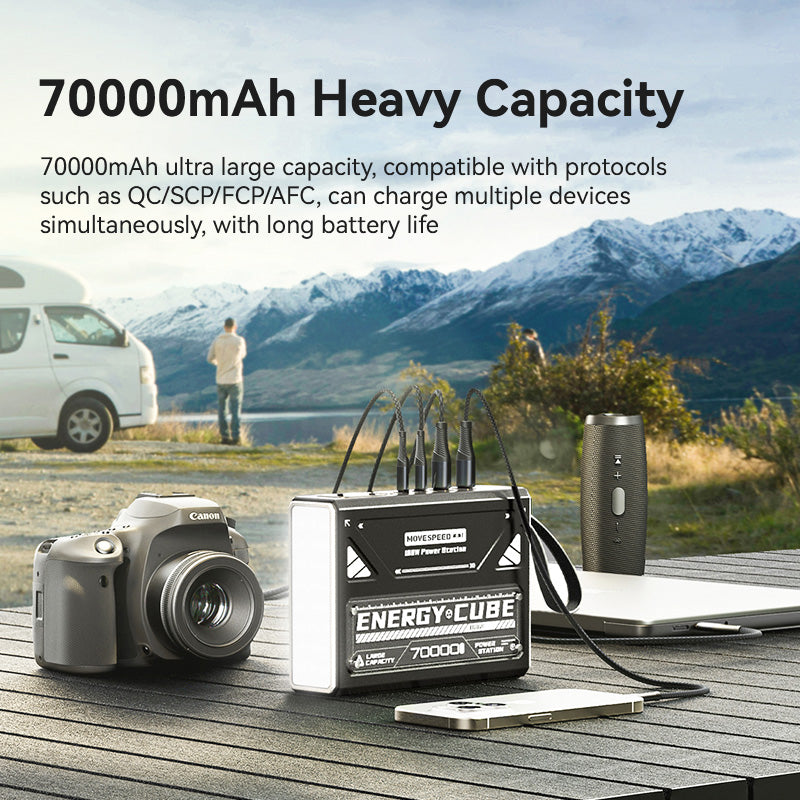
MOVESPEED's solid-state power bank lineup is built for exactly this kind of user: people who need next-generation portable charging that keeps pace with demanding devices and demanding schedules.
How to Evaluate Solid-State Power Bank Claims Before You Buy
As solid-state gains traction, so does marketing drift. Some brands label products as "solid-state" when they use only marginally less liquid electrolyte than standard lithium-ion. Here is how to cut through the noise.
- Ask for the liquid electrolyte percentage. Legitimate semi-solid-state products will cite under 10% liquid content. Vague claims like "solid-state inspired" or "solid-state technology" without specifics are red flags.
- Check third-party safety certifications. Look for testing against recognized thermal runaway standards. If a manufacturer cannot point to independent validation, proceed with caution.
- Look at cycle life specs. A genuine semi-solid-state cell should rate 1,000+ cycles. Anything near 500 cycles is almost certainly standard lithium-ion with a marketing upgrade.
- Use warranty length as a confidence signal. Manufacturers who stand behind their longevity claims offer longer coverage. Short warranties on supposedly "solid-state" products suggest the chemistry does not match the branding.
The global solid-state battery market is projected to grow from roughly $1.6–$2.3 billion in 2025–2026 to $15.7 billion by 2033, expanding at a CAGR of approximately 31.8%. That growth will bring more vetted options to market, but right now buyer scrutiny matters more than ever. Do the homework before you hand over your money.
The Verdict: Is Solid-State Worth It Right Now?
Here is the honest answer. Semi-solid-state power banks are a genuine, meaningful upgrade over lithium-ion in safety and longevity. They are not marketing hype. True all-solid-state remains a technology of the 2030s.
The roughly 40% price premium is real, but it is justifiable when you account for double the cycle life, substantially reduced fire risk, and growing travel safety advantages. The global power bank market is on a trajectory from $20.9 billion to $39.5 billion through 2033, and solid-state will capture an increasing share as manufacturing costs fall.
For tech-forward consumers who demand the best performance and safety from their gear, semi-solid-state is the right call today. For budget-first buyers, high-quality lithium-ion from reputable brands with transparent recall histories remains a viable option.
The shift from liquid to solid electrolyte is the most important battery transition since lithium-ion itself. It is already underway. Technology accelerates life, and this is one of those moments where the acceleration is measurable, testable, and worth investing in.